The Kingdom of Ambition: How Saudi Arabia is Building its Future with the Fuel of AI
Have you ever wondered how a nation can redraw its future in only a few years?
Saudi Arabia’s story with artificial intelligence is not just a collection of disconnected technology projects. It is a national transformation shaped by strategy, data infrastructure, digital government, investment, local capability, and ambition.
The mastermind: a clear strategy and vision
Every great structure begins with a blueprint. In Saudi Arabia’s case, one of the clearest blueprints is the National Strategy for Data & AI, which positions data and AI as central enablers of the Kingdom’s future.
A strategy alone is not enough. It needs coordination, standards, governance, and execution. This is where the Saudi Data & AI Authority plays a major role by coordinating national data and AI efforts and supporting the wider goals of Vision 2030.
AI in daily life: more than a technical idea
The impact of AI becomes meaningful when it improves services, decisions, and daily experiences. In Saudi Arabia, this appears across multiple sectors.
Healthcare
Digital health and virtual care show how technology can expand access and improve responsiveness. Platforms such as Seha Virtual Hospital reflect a direction where medical expertise, remote care, and connected services become part of the national health infrastructure.
Energy
In the energy sector, Saudi Aramco has described the use of big data and AI to support operational efficiency, including systems that help predict when facilities may exceed flaring targets. Aramco also reports that AI-supported flare minimization initiatives contributed to reducing total flaring by more than 50 percent since 2010. See Aramco’s pages on AI and big data and the AI Hub.
Digital government
Digital government platforms make services easier to access and improve. When public services become digital, they generate clearer workflows, more measurable processes, and stronger foundations for future intelligent services.
NEOM: a laboratory for future urban systems
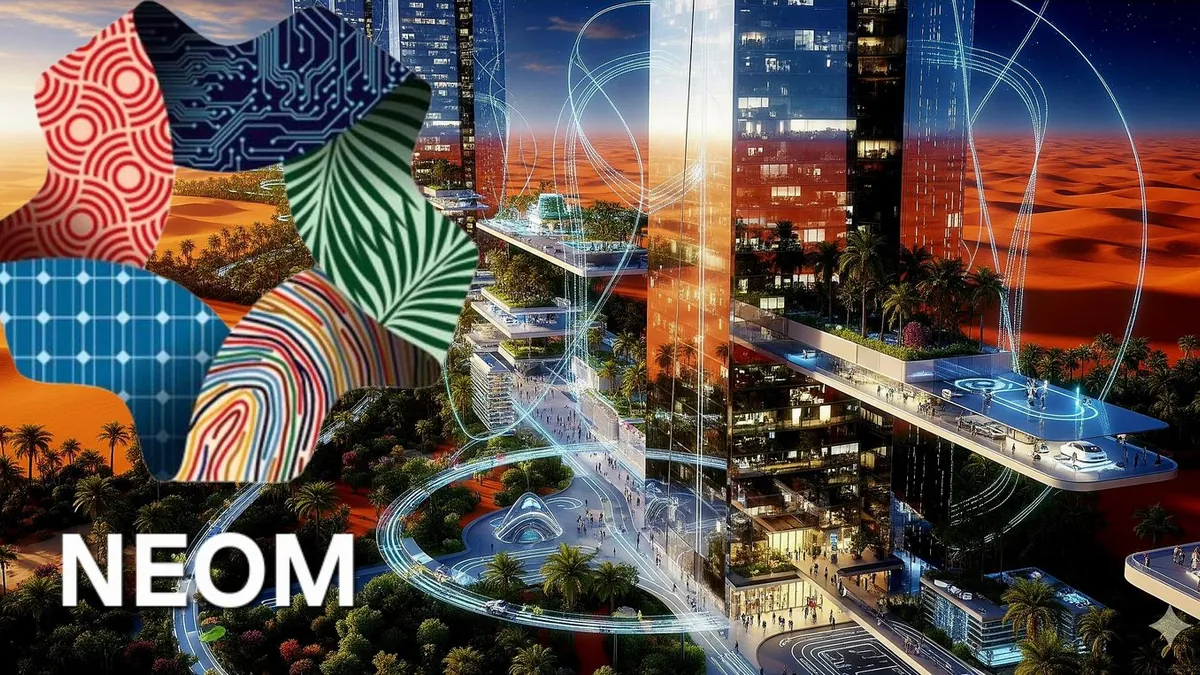
NEOM represents one of the boldest examples of Saudi ambition. Its technology and digital direction emphasizes connectivity, data, digital infrastructure, and cognitive technologies. NEOM describes this direction through its Technology & Digital sector and its vision for cognitive cities and connected digital services.
The important point is not only that a city uses technology. The larger idea is that the urban environment itself can become more adaptive, connected, and data-informed.
Made in Saudi: from consumption to sovereign innovation
True leadership in AI is not only about using tools developed elsewhere. It is also about building local capability.
The Arabic large language model ALLAM is an important example of this direction. It reflects the need for models that understand Arabic language, local context, and cultural nuance. HUMAIN Chat presents this capability as a user-facing service built for Arabic speakers and powered by ALLAM; see the HUMAIN Chat launch page and the HUMAIN Chat app listing.
This kind of work matters because language is not just translation. It carries culture, context, values, and expectations.
A rising global power in AI
Saudi Arabia is also positioning itself globally through AI events, partnerships, and national initiatives. The Global AI Summit has brought international attention to Riyadh as a place for dialogue on artificial intelligence, policy, research, and innovation.
Conclusion
Saudi Arabia’s AI journey is a story of ambition backed by strategy, investment, and execution. The Kingdom is not only adopting the future; it is actively building the foundations for it.
For me, the most interesting lesson is that AI succeeds when it is connected to systems: institutions, data, services, culture, people, and measurable value. That is what makes the Saudi AI story worth following.