Text preprocessing and linguistic normalization workflow
This project implements a practical text preprocessing pipeline for noisy English content. It focuses on cleaning real-world patterns, normalizing language, and inspecting linguistic structure before downstream modeling or analysis.
Challenge
- Noisy text often contains emails, URLs, dates, hashtags, mentions, punctuation, contractions, and spelling variants.
- Downstream NLP quality depends heavily on the consistency of preprocessing decisions.
- Ambiguous words and morphology require more than simple string removal.
System architecture
Data and inputs
- Example noisy English text covering emails, URLs, phone numbers, dates, contractions, hashtags, mentions, and spelling variants.
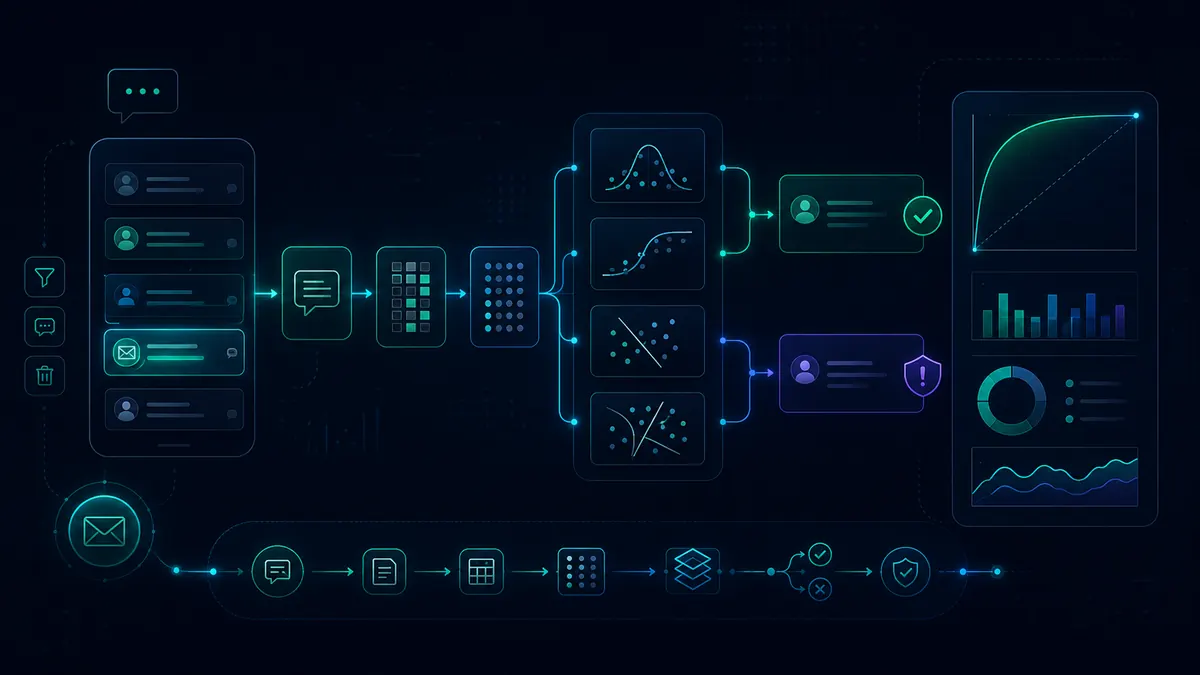
- The workflow is organized as a reusable language-preprocessing pipeline.
- Outputs include pipeline-component summaries for review.
Technical approach
- Remove or normalize common noisy patterns using regular expressions.
- Apply tokenization, lowercasing, contraction expansion, punctuation handling, stemming, and lemmatization.
- Use NLTK and spaCy for sentence/word tokenization and POS tagging.
- Inspect contextual ambiguity with examples such as company-versus-fruit uses of the word apple.
Evaluation and results
Emails / URLs / dates handled
Tokenization and normalization pipeline
Stemming, lemmatization, POS review
- The pipeline covers common text-cleaning cases that frequently appear in real-world NLP datasets.
- The workflow produces structured preprocessing outputs that can be reused before modeling.
- The workflow highlights how linguistic context affects interpretation, not just string cleaning.
Implementation and code
Implementation focus
The implementation connects data preparation, modeling, evaluation, and interpretation in a structured workflow that makes the technical decisions clear.
Source code
The code is available for exploring the implementation details and extending the experiment when needed.
Scope and responsible use
The project focuses on language-data modeling and evaluation. Broader use would require domain-specific validation, edge-case assessment, monitoring, and testing on fresh data.
Future development
- Add configurable preprocessing profiles for different text sources.
- Extend support to multilingual text and domain-specific patterns.
- Add automated unit tests for edge cases and ambiguous examples.
Technical contribution
The project demonstrates the engineering foundation behind text analytics: turning noisy language into consistent, analyzable inputs while preserving enough linguistic structure for downstream tasks.