Classical vision preprocessing and boundary extraction
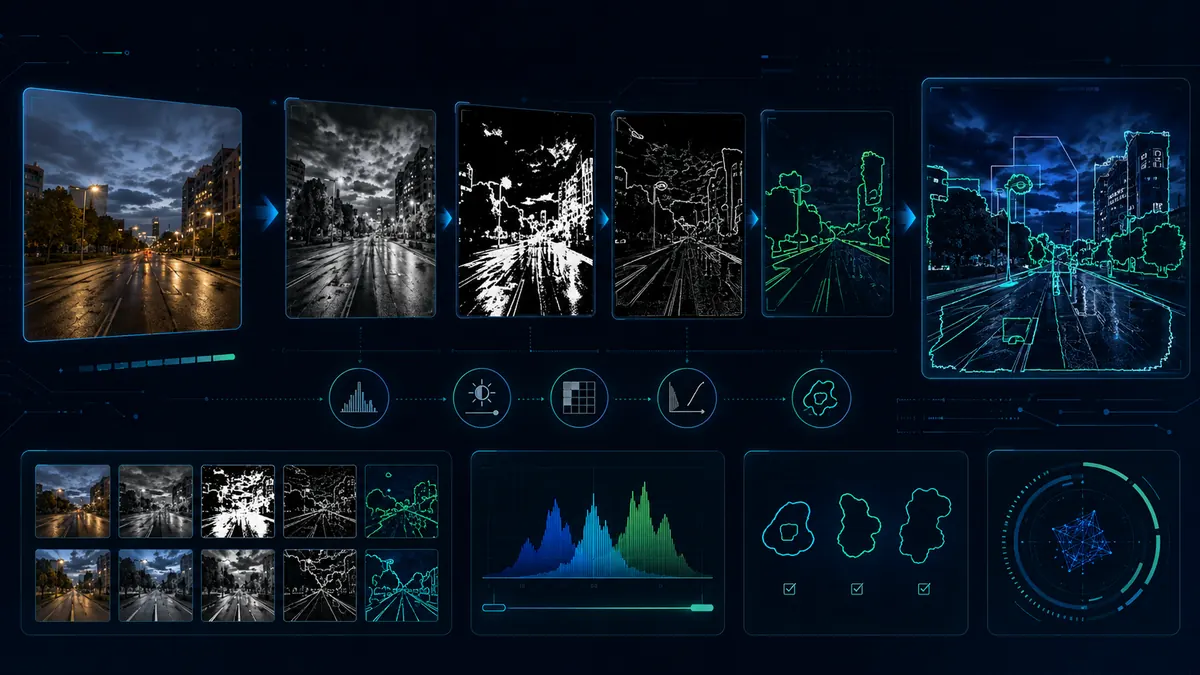
This project explores how classical image-processing techniques can improve visual structure before downstream computer-vision tasks. It applies contrast enhancement, thresholding, edge detection, contour analysis, and frame-by-frame video processing to natural visual samples.
Challenge
- Natural scenes often contain uneven lighting, shadows, texture, and background clutter.
- Preprocessing needs to improve visibility without destroying useful structure.
- The same logic should remain interpretable when applied to both still images and video frames.
System architecture
Data and inputs
- Small set of real-world images from Open Images.
- Short video clip processed frame by frame with the same enhancement-and-edge logic.
- Outputs include CLAHE comparisons, thresholding results, edge maps, contours, and simple processing-quality metrics.
Technical approach
- Convert images to grayscale for intensity-focused processing.
- Apply CLAHE to improve local contrast without overexposing bright regions.
- Compare Otsu and adaptive thresholding for foreground/background separation.
- Use Canny edge detection and contour filtering to make boundaries easier to inspect.
Evaluation and results
Open Images visual samples
CLAHE / adaptive threshold / Canny pipeline
Image and video preprocessing workflow
- CLAHE improved local contrast in outdoor scenes without excessive brightness distortion.
- Adaptive thresholding handled uneven lighting better than global Otsu thresholding.
- Canny edge detection preserved important boundaries while reducing background noise.
- Edge density and contour-area statistics provided simple numerical indicators for comparing outputs.
Implementation and code
Implementation focus
The implementation connects data preparation, modeling, evaluation, and interpretation in a structured workflow that makes the technical decisions clear.
Source code
The code is available for exploring the implementation details and extending the experiment when needed.
Scope and responsible use
The project is a focused modeling and evaluation study. Broader use should be supported by validation on additional data, robustness checks, monitoring, and domain-specific evaluation.
Future development
- Test the pipeline on larger and more diverse visual scenes.
- Compare handcrafted preprocessing with learned segmentation or detection methods.
- Add interactive controls for threshold and contour- filtering parameters.
Technical contribution
The project demonstrates disciplined visual preprocessing: understanding image structure, comparing classical methods, and turning raw visual inputs into interpretable boundaries.