Adversarial image generation and training-behavior analysis
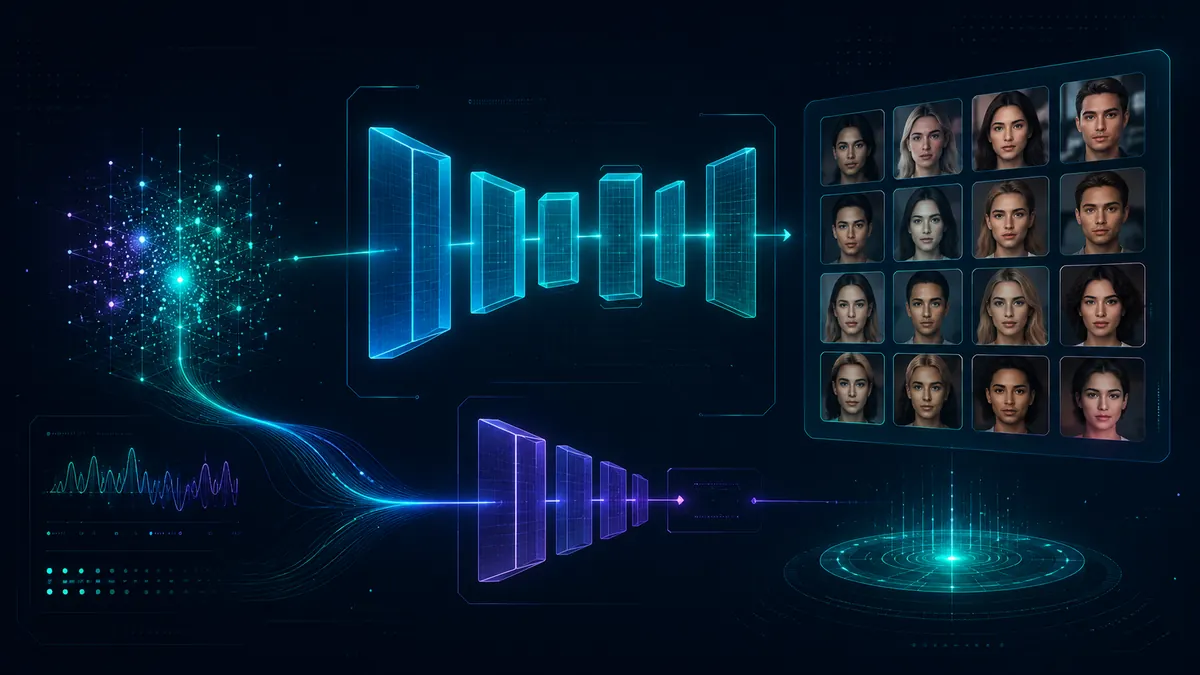
This project implements a DCGAN-style workflow for synthetic face generation on CelebA. It studies generator/discriminator behavior, sample progression, and the practical instability of adversarial training.
Challenge
- Generative image modeling needs inspection beyond a final sample grid.
- GAN losses are difficult to interpret because two networks compete.
- Generated samples can improve while still showing artifacts and blur.
System architecture
Data and inputs
- CelebA face image dataset with 202,599 images.
- Images resized to 64×64 for the DCGAN workflow.
- Training setup uses 15 epochs and saves generated samples/checkpoints.
Technical approach
- Generator maps latent noise vectors into synthetic images.
- Discriminator learns to distinguish real images from generated samples.
- Training tracks both networks and saves outputs across epochs.
Evaluation and results
202,599 source images
64×64 generated outputs
15 training epochs
- Generated outputs began showing recognizable face-like structure.
- Artifacts and blurry regions remained, which is expected for a basic 64×64 DCGAN setup.
- The project highlights why generated samples and checkpoints are important for diagnosing training progression.
Implementation and code
Implementation focus
The implementation connects data preparation, modeling, evaluation, and interpretation in a structured workflow that makes the technical decisions clear.
Source code
The code is available for exploring the implementation details and extending the experiment when needed.
Scope and responsible use
The project is a focused modeling and evaluation study. Broader use should be supported by validation on additional data, robustness checks, monitoring, and domain-specific evaluation.
Future development
- Experiment with stronger GAN architectures and higher-resolution training.
- Add quantitative image-quality metrics and sample grids by epoch.
- Explore latent interpolation and controlled generation behavior.
Technical contribution
The project demonstrates adversarial learning as a workflow: architecture, training dynamics, sample inspection, and practical limits of simple generative models.